Rigging a slot game character in Riggy: the Qubix hacker cat, prompt by prompt
We used chat in Riggy to rebuild the hacker cat from Bottle Cap Gaming's Qubix: Glitch City as a Spine 4.2 rig from a layered PSD. Its celebration animation took 2 prompts and $0.65 on the existing rig. Here is the result first, then how each of the four animations was made, with the prompts as they were written.
The result
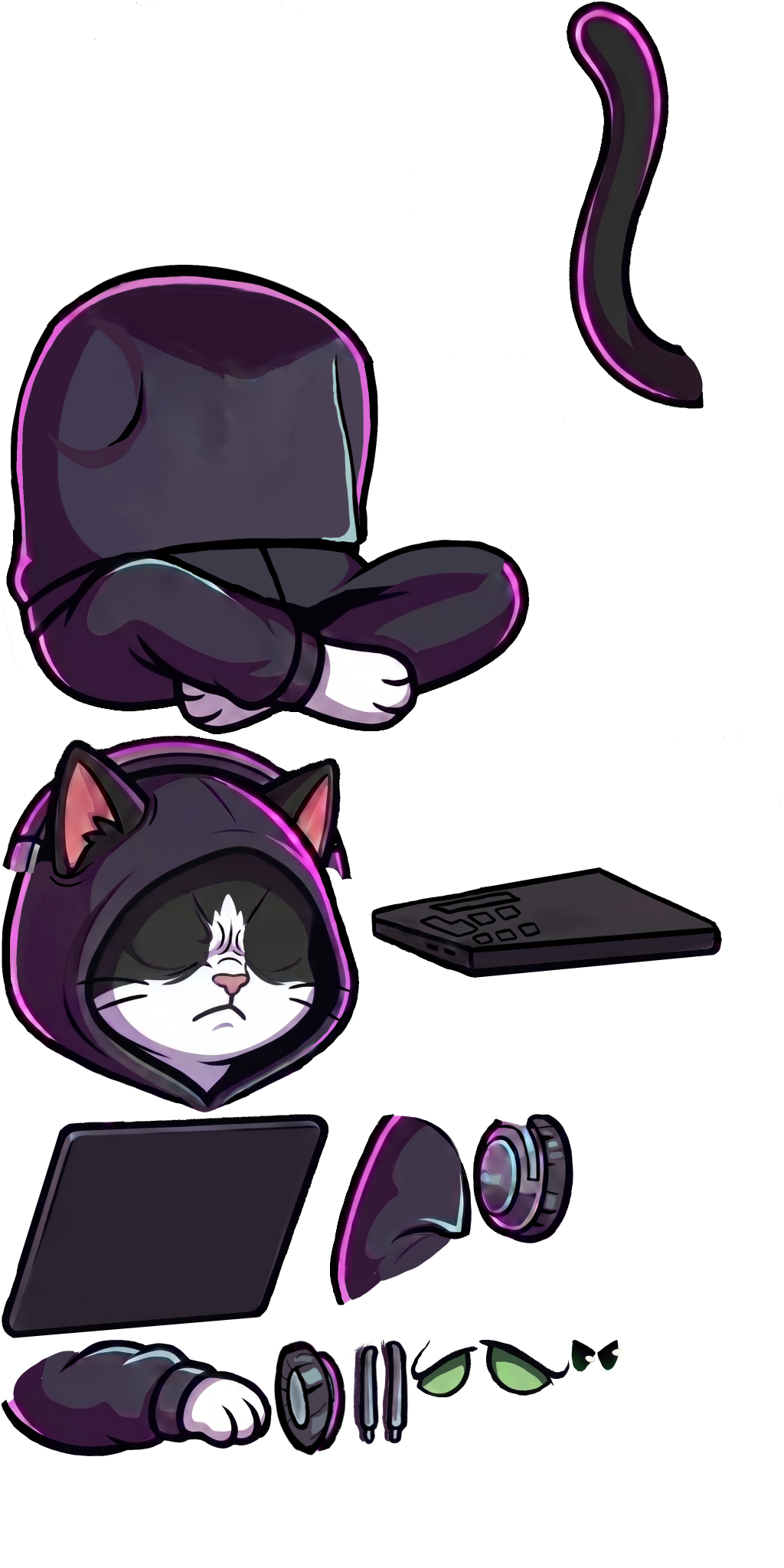
Click the demo to switch between idle, hack, glitch and bigwin — the exported files playing in the official Spine runtime. This is what went in: 15 parts cut from the PSD, packed onto one texture page.

What the game needed
Each animation has a role in the game and is timed to the board: idle running underneath everything, hack when the cat starts a line rewrite, glitch when a glitch block appears, bigwin while a mega cluster is on screen. The game stretches or squeezes them to its own timings. An earlier version of the rig was already in the game; this session rebuilt it from a 15-layer PSD. The story of the character from the game's side is on the studio's blog: A character that plays along.
Initial bone placement: one prompt
Place the bones. Put each one in the right spot and point it the right way.
One prompt placed 18 bones — hip, chest, neck, head, headphones, a two-piece arm, laptop, laces and tail — and moved every part onto its bone without shifting anything on the canvas. Two corrections came later: the tail bone flipped by hand to grow from the base, and the head pivot, below.
bigwin: 2 prompts, $0.65
bigwin: next animation. The cat sways its head left and right to the music, 90 BPM, raises its paw a little and waves it in time with the head, as if greeting someone. The headphones pulse like in idle.
Add a small smooth tail sway as well.
On a rig that was already set up, this is what working in Riggy looks like: describe the motion in plain words — beat, direction, what moves with what — and get a loop. The head sways on the beat, the paw waves in time with it, the headphones pulse like in idle, and the tail sway sits on top. Switch the demo above to bigwin to see it.
hack and glitch
hack: new animation. The cat raises its paw and slams the keys, the laptop jumps a little, and the eyes go wide at the same moment.
The strike — wind-up, a linear slam, recoil — was right on the first try; the direction was not. The paw hit the keyboard from below, because rotation sign in Spine depends on which way the bone points. One more prompt fixed it by reusing the sign of the typing motion already in idle. Riggy now tells the model where a key moves the tip of a bone in world space, which is exactly the information that was missing. The laptop recoil was tuned last, by hand in the motion editor.
For glitch the game already had a clip from the earlier rig. Described in words — stepped curves, a plateau of jerks, three peaks — the model got close; then the clip's key tables were pasted into the chat:
Here is the full spec of glitch, the exact key tables it is played from elsewhere: 0.6 s at 30 fps, every key on the 1/30 grid, stepped everywhere, a closed loop. body translate, 10 keys; head translateX, 10 keys; head scaleX, 10 keys; and so on for the pupils, eyes, laptop, forearm and tail.
The model transcribed them one to one. Checked against the final rig: all 11 tracks and 95 keys match the pasted tables value for value, every key is stepped, and the three glitch markers sit at 0.0, 0.3 and 0.5 s as they did. If you already have the numbers, paste the numbers.
Refining the idle: the head pivot
The first idle — a listening loop at 90 BPM — came from one prompt. For the head to nod forward from the neck, its bone had to sit at the base of the neck, not of the head. Dragging it there with the mouse moved the pivot without moving the picture, and one short prompt finished the loop:
A forward bob on every beat at 90 BPM, and six of those beats.
The same move is now available to the model too — it can shift a pivot without moving the picture — and a pseudo-3D head turn can rotate around its bottom edge. Repeating a motion over the whole loop ("six of those beats") is a single tool call. After that, the darting eyes, the typing hand and the headphones pulsing on the beat were one short prompt each.
What it costs
You pay per prompt, and every prompt in this session cost under a dollar — the ones quoted above show their price. Moving a bone or nudging a key at a moment with the mouse is free, and so is undo.
Put it in your engine
The export is plain Spine 4.2 JSON and an atlas. Step-by-step guides with the same cat: Phaser 4, PixiJS 8, Unity. Shipping a game with the Spine Runtimes requires a Spine license from Esoteric Software, whoever made the skeleton — see licensing.